Expedition Teacher: world schooling by sailboat

Can you imagine teaching little kids aboard a sailboat, while exploring dreamy tropical places on a big catamaran — sailing around the world in places like French Polynesia, Seychelles, and spots in between? You might be in luck 🙂

We are launching a world schooling expedition this year. Our vision is to create an innovative nature-led program, connected with kids back home through partner schools. At the heart is our Green Coco cooperative, a community of families and adventurers joining us along the journey.

You’ll be spending lots of time with our nearly 4yr old twins, Kaiana and Naiyah; plus a number of other visiting kids who stay for 7-14 day periods. As a mentor-teacher, you’ll guide their daily learning and also help create our broader education program.

Commitment: 1.5 month to 12 month periods. Teaching certifications are not necessary, but teaching experience is desirable, especially with Waldorf/Montessori/RIE training. Fluency in French or Portuguese is also a big plus.

The Green coco Expedition is a community adventure. We host groups of 3-6 people, usually people we know through the Green Coco Cooperative, including families, couples and singles. In each month, we usually have guests aboard 15-20 days.

All expenses covered while aboard. Travel expenses covered if staying longer periods (up to $1000 for 3+ month stay, up to $2000 for 6+ month, conditions apply).

Stipends are available for qualified individuals (chefs, pre-school teachers, especially those experienced with Waldorf/Montessori/RIE). A yearly salary is possible for the right candidate who has the initiative and skill to launch an educational program. Note, we may accept couples if the second person has deckhand/mechanic/electrician qualifications, or high levels of teaching experience.

How to apply:

1. Read about our Parenting Philosophy, Qualifications, and Expectations below

2. Please complete our application

3. Send us a simple intro video about yourself (selfie is fine, 2 min max) and resume (doesn’t have to be fancy, just a summary write up of your experiences is ok too). Send both the intro video and resume to greencocosailing@gmail.com

dates available for teacher position:

  • Oct 3-17, 2023 Brazil (via plane from SFO, land time in Peninsula Marau & Rio)
  • Oct 18-Jan 22, 2024 Marquesas (via plane from Papeete, then aboard 46ft cat. Includes festival)
  • Jan 23-April 15, 2024 Seychelles (via plane from SFO, then aboard 60ft cat)
  • April 12-July 15, 2024 Seychelles and Madagascar (aboard 60ft cat)
  • July 5-October 5, 2024 Madagascar, Mozambique, South Africa (aboard 60ft cat)
  • October 1-November 30, 2024 South Africa
  • November 22-January 22, 2025 Atlantic Crossing or land time in Brazil

To see our complete schedule, check out our charter website.

about us:

in 2015 we left our jobs in California and over the next 4 years, sailed south with our Green Coco sailing cooperative to Galapagos, and across the Pacific ocean to French Polynesia. We fell in love with the country and decided to stay, start a family and a business.

In 2020 our twin girls were born and we upgraded to a 46 foot catamaran, Selaví (pronounced C’est la vie). We continue to run trips that are focused on wellness and family friendly adventures. For example, we teach wholesome cooking, freediving, breathwork, yoga, meditation, and sailing. We’ve hosted families with babies as young as 8 months.

Late 2023 we will be in Marquesas, and in February 2024 we move aboard our new 60ft catamaran in the Seychelles to begin a world schooling expedition back to California. We aim to have a full-time teacher for this period. Read more on our blog: http://www.greencoconutrun.com

We live aboard the boat 24/7 and are never at a marina, always at anchor. We are really active with swimming, snorkeling, free diving, surfing, kitesurfing, and SUPing. We try to bring the twins along with us in activities whenever possible.

During the past years, we’ve cruised between Tahiti, Leeward Society Islands, and Tuamotus, see our schedule. See our latest newsletter for a sampling.

our parenting philosophy:

We feel that children are special beings that choose their parents to guide them in this life. As their guides, we do our best to lovingly & securely offer them choices so they can fulfill their highest potential.

We follow the RIE parenting model which focuses on treating infants with respect (ie. the golden rule… act like you would like to be treated yourself by a friend) and honoring their ability to make choices (based on their current level). This post offers a good summary of RIE.

Whereas some parents focus on “raising good kids” and “keeping their kids safe and comfortable”, our focus is to #1 respect and #2 empower our kids.

It might help to understand what we try to avoid:

  • Saying No. Instead, we say: “we can’t let you do this, because it is unsafe for these reasons…”
  • Being overprotective. Instead, we say ” this is dangerous, watch out”
  • Serious injury or trauma.
  • Being over-comforting. Instead of “you’re ok baby, don’t worry”, we say. “you look scared, what happened?” . We don’t dismiss their experience for the sake of comfort.
  • Doing things mindlessly, without their consent. We act and communicate with presence.
  • Sugar (white & brown), with the goal to promote wholesome nutrition
  • Screen time, with the goal to promote creative imagination (the exception is engaged learning activities)

In a parallel way, RIE is for infants as Non-Violent Communication (NVC) is for adults. Both are methods for overcoming our judgments and instead focusing on observation, presence, and empathy. Learn more about NVC here.

As our onboard teacher and crewmember, we would ask you to practice RIE and NVC principles . It’s ok if you’re not familiar with these concepts. The most important thing is intention and interest in these principles. We will offer you further training in the form of basic materials to read beforehand, and more in-depth while onboard.

qualifications:

  • pre-school teaching experience is not mandatory, but it is very helpful. Waldorf & Montessori particularly welcome.
  • child care / nanny experience is not mandatory, but it is very helpful
  • RIE / NVC knowledge is not mandatory, but interest is required and advance study before coming aboard.
  • Characteristics desired: patience, supreme patience. Creativity, optimism, stoke, positive attitude, responsibility, autonomy, respect, compassion, self-starter, highly independent
  • Skills desired: cooking for groups (up to 12 people with diverse diets); ocean competency (strong swimmer, confident in ocean); and being an amazing host/hostess.
  • Languages: French is a big plus; and Portuguese. English fluency is necessary. For 2025, Spanish fluency will be desirable.

expectations:

What can you expect from working as an onboard teacher on Green Coco?

  • You will be joining our family unit. As such, personality, positivity and strong work ethic is most important. We take care of each other and work together to ensure play and work are balanced for everyone. We are flexible and love empowering people to do things they are excited about, or giving them breaks if they need time off.
  • “Pre-school” hours are typically 9-2pm (5hrs). Then there might be a few extra hours of helping around the boat or with the girls in the afternoon/evening, depending on activities of the day.
  • In addition, we take turns cooking meals & cleaning, so you can expect to make one meal each day or every other day (depending on your activities, #of people aboard, etc) as your contribution to the meal schedule aboard the boat, about 1.5 hrs total.
  • We work really hard and play hard. This is best suited for those super eager and have plenty of energy, and desire to spend time in the ocean, learn sailing, and are able to play independently (e.g. go for a swim or paddle on your own to shore). You’ll be in some of the world’s most beautiful islands.
  • Outside of preschool hours, time with the girls is more than just passive child care. To the extent possible, we allow them independent play time, during which time we also fold laundry, prep food, clean dishes, etc. We also try to include the girls in these daily activities of life. Like a parent, you’ll be juggling multiple things to get life tasks done.
  • As we usually have other guests on board, you’ll be helping when possible as a crew member.
  • You’re only on call during the day, not nighttime, except on occasional evening for date nights 🙂

accommodation

When there is space, you can sleep in your own cabin with private bathroom (labelled Aft Cabin below).

When there are guests aboard, you’ll take the single berth with shared bathroom (labelled Single Berth below)

See a Boat Tour video here.

compensation:

Once you’re aboard the boat, all your costs are covered (food and accommodation, beer & alcohol not included).

Minimum commitment is 1.5 months. For suitable applicants staying 3 months we can cover travel expenses. For highly qualified applicants, we can offer stipends (such as chefs, or those experienced in RIE parenting/ whole child teaching like Waldorf, Montessori, or Reggio Emilia).

Please see our charter website pricing to understand the value of what you get riding for free aboard.

The places we visit with our guests are world-renown and absolutely stunning. We try to include you in as many activities as possible so your stay can be super memorable.

Our unique brand of cooperative charters means that guests are treated as family aboard the boat, participating on the operations as they can. Similarly, we treat our deckhands and teachers as family too. Everyone eats together family-style, and takes turns making meals according to the meal schedule.

As part of your stay, we offer you valuable training in sailing, off-grid cruising skills, breathwork, and non-violent communication.

how to apply:

1. read all the info above.

2. Please complete our application

3. send us a simple intro video of yourself (selfie is fine, 2 min max) and also a resume (or summary of your relevant work experience in writing). Send both the intro video and resume to greencocosailing@gmail.com

Thanks so much for your interest!

Connection: Hidden in Plain Sight

There’s something that photos don’t typically capture. We ask people: “what’s your favorite thing about sailing with us?” They say, paradise beaches, epic snorkeling, gourmet food, and the twins(!). Then a surprisingly common thread stands out:  the sense of connection aboard the boat.

Despite our instant access to everything, the feeling of ‘disconnection’ is becoming commonplace in our modern world. The busy-ness of life, constant tech distractions, superficial relationships at work… our attention jumps around, we’re hardly ever fully present with one another. This is one of the true gifts of doing a trip together — whether it’s camping, on an RV, or by boat. We remove all the distractions of life and get-fully-there. 

When else do we have regular, meaningful conversations and get to know people deeply, after days of meals and play? I’ve had those moments while backpacking with friends, or riding a long train trip. The special part about a sailboat trip is getting this sense of connection… three times over.

Kalia and Allegra in Bora-Bora

First… our relationships are deepened by eating and playing together without the distractions of technology. We don’t have to coordinate many logistics; we can just go with the flow. It’s much easier than backpacking for example; and on the other extreme, it’s much more human size than cruise ships!

Shannon, Toby, and Serena in Fakarava this year

Second… our connection with Nature is deepened as we constantly tune into the weather. What are the winds doing, the stars, the moon, the squalls and sun? Each shift in Nature’s expression is immediately seen & appreciated. Sailing itself is a super satisfying, a moment-by-moment dance between the wind, our sails, and our steering. 

Third… our connection with ourselves reaches a new level. Aboard a sailboat, together as a group for a multi day trip, we can’t hide behind TV shows or say “see you later” when we have ups and downs. We learn to feel our emotions and understand them. At first this can be intimidating, and many people think they can only handle 5 days of this “mirror of Life”. With journaling and our intentional check-ins, however, many people find this opportunity of self-reflection to be surprisingly liberating. 

Huahine

If greater connection is one of your intentions for this year, organize a trip with friends or family…Rent a house for the weekend to gather people… Rent an RV for the week… and simply play together. And if an ocean adventure is calling you, we welcome you to join us aboard a Green Coco trip for that greater connection and experience what sailboat life is all about. 

More information about our adventure-loving, family-friendly, wellness-focused charters: http://www.greencococharters.com

HAPPY NEW YEAR! 2023 is here!

We’ve been silent this last year. Somewhere between changing baby diapers, changing engine oil, and hosting guests aboard our trips, we’ve been wrapped up in the moment. But now we are coming out of hibernation, and we’re ready to share a bunch of exciting news!  

First a little recap about our last year. Thanks to the help of some super-nannies, we survived the “terrible twos” with twins. Our girls Kaiana and Naiyah have been thriving in the life aboard, enjoying the company of our guests and becoming strong little girls.

Kaiana and Naiyah, at 2 years of age. They are turning three, end of Jan ’23

We spent the first half of the year hosting guests in the atolls of the Tuamotus archipelago, which we love for their raw, wild nature and authentic feeling. Multitudes of fish, reef sharks, glorious empty beaches, and welcoming locals make this place super special.

One of the sweet families we hosted this year in Tuamotus, with Simon and Wesley aged 7 and 9 from Michigan

The second half of the year was in the Society Islands — the dreamy islands of Tahiti, Moorea, Huahine, and Bora-Bora. They have a bit of everything: gorgeous lagoons, nice hikes, beach side happy hours, and comfy anchorages.

Great times in Bora-Bora with a SLO county family

The end of year was an intense rollercoaster of ups and downs, including some rough weather, COVID scares, and volunteer crew debacles. We survived, and had a glorious overnight sail to reach Tikehau atoll, in the northwestern corner of the Tuamotus archipelago, where we are now. 

More stories coming.. stay posted! Feel free to ask questions in the comments, or just share if you’re enjoying our re-awakening from hibernation 🙂 

The back porch…

More information about our adventure-loving, family-friendly, wellness-focused charters: http://www.greencococharters.com

How to swim with sharks in French Polynesia

We recently had a debrief with our crew about swimming with sharks, and thought we’d share with you. Here’s what we have learned so far during our trip…

BLACK TIP AND WHITE TIP REEF SHARKS
These sharks are easy to identify and are pretty much harmless; most of the time they are scared of people. They are typically 4-5ft with some individuals getting bigger (although some photos trick you into thinking they are larger!)

Their mouths are small and they are unable to bite things much larger than a fish. They are extremely cautious; they’ll circle a fish head several times and poke it before attempting to bite it. If you get them into a frenzy (lots of bloody fish attracting lots of fish and sharks) then they get more jumpy, but they are still pretty wary. This is generally true of all sharks because as predators they can’t afford to get injured — catching food is tough when wounded, and they might starve.

Incidents of black tips and white tips injuring humans seem to be extremely rare. One young diver in Fakarava got too close to frenzied sharks while diving at night (which happens to be their feeding time) and a shark knocked his regulator, yanked it out of his mouth, requiring several stitches to the young diver’s lip.

A more serious incident occurred with our local friend when he was nine years old; he was splashing around in poor visibility water and a black tip bit his butt! His gluteous maximus required several stitches. From what I can tell, this is characteristic of the vast majority of shark attacks on humans: in poor visibility, the shark bites a person by mistake thinking they are a fish (or seal, in the case of great whites). They realize their mistake and most often don’t bite again.

GRAY REEF SHARKS
They are much more hefty and bold than the black & white tip sharks, typically around 6-7 ft. Everyone claims they are safe to swim with. However, they can sometimes be uncomfortably “curious”, investigating who you are. In that scenario the best way to persuade sharks to move away from you is to face them directly; you become much larger, and are not exhibiting prey behavior, so they distance themselves. Making eye contact is also an effective way to shoo them away; like dogs, sharks are intimidated by your gaze.

The main instance in which gray reef sharks are in fact dangerous is during spearfishing. If you shoot a fish the shark will happily try to grab it regardless if the fish is on the spear or in your hands. So the protocol for spearfishing with sharks is to have a buddy who can pull up your float line with spear gun and wounded fish as fast as possible; and the spearfisher stays away. If solo, people take care to ensure there are no sharks in the vicinity and they try to get the fish out of the water as soon as possible. The Tahitian name for this shark is “Raira”, and we often heard the refrain from our friend Bruno in Faaite, who took our crew spearfishing: be careful with the Raira when you catch a fish!

Hungry Wolves in a Food Desert


the hungry wolves… don’t be fooled by their suave appearance, they’ll eat everything within sight


“You guys should bring protein powder and lots of granola bars. I’m not sure how much food we’ll be able to find out here…” I told Michael. The supply ship to Fakarava had broken down so the atoll was in a slight food panic. 

Michael was visiting us in Fakarava, along with our three other high caloric intake friends – Alex, Ben, and Johnny. Our ship’s dry stores were plentiful, but the fresh food had dwindled over the last two weeks during our passage from Marquesas. How would we feed the hungry wolf pack and sustain the froth for surf, diving, and exploration??

Here’s where it pays to have great cruiser friends. Our buddies Tom & Sonya on Pakia Tea were anchored at the village of Fakarava, a full days sail (from where we were in the south pass). The winds were also very strong, gusting to 25knots. “The supply ship is finally arriving tomorrow,” Tom reported. “But you’ll never arrive on time for the fresh stuff, the food will be gone by noon.” 


our food saviors, Tom and Sonya on their catamaran Pakia Tea (pronounced Teh-ah). We met in the Galapagos, crossed the Pacific and met in Gambier, and now met again in Tuamotos!


Thankfully, they kindly offered to buy fresh produce for us at the village, and sail it down to us. I suppose they were repaying a favor: last month, we had sailed 30lbs of pamplemousse and limes from Marquesas to deliver to Tom & Sonya, who had been in Tuamotos for months already. 

What goes around comes around… we were very grateful for our friends delivering the food. Now we could start the trip with the fellas with plenty of groceries.


Three great days in Fakarava


Our view from the anchorage of a nice bungalow overlooking the lagoon


Some places are best described by the pictures… Fakarava is one of them. 

The comment in the previous post from Ellen & David was telling: they said this was their best snorkeling & scuba from several years sailing around the world. I hope this shows a glimpse of what they mean…


A surprise on the way the the restaurant… what’s that in the water??


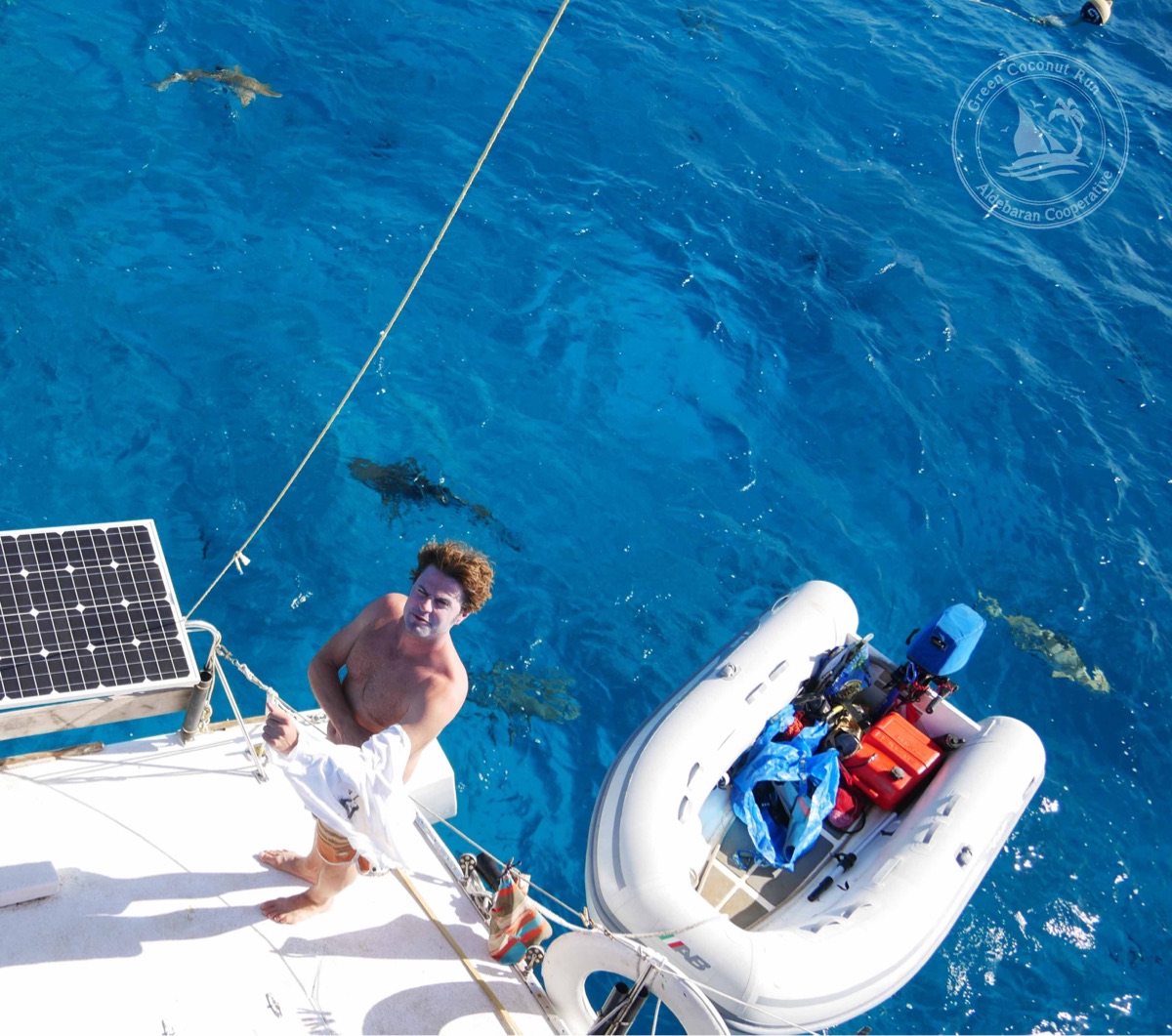
The cook is filleting fish and throwing the leftovers to the blacktip sharks, swarming like hungry dogs!


Hum… it’s just 2 feet deep, but does anyone want to go swimming? check out the next photo.


Sabby cruising through the blacktip shallows. Turns out they are totally harmless.


The snorkeling in Fakarava’s south pass is a feast for the eyes.


Although the pass itself is 80 feet deep, the steep coral walls rise up to 3 feet deep, making for perfect visibility in shallow water.


Captain K freediving and stoked


Schools of fish congregating around the pier pilings owned by the dive center.


Numerous fish taking shelter under the boats.


A fat Napolean wrasse non chalantly munching on the reef’s goodies.


Next to the coral wall, looking up at the silvery water and the colorful fish.

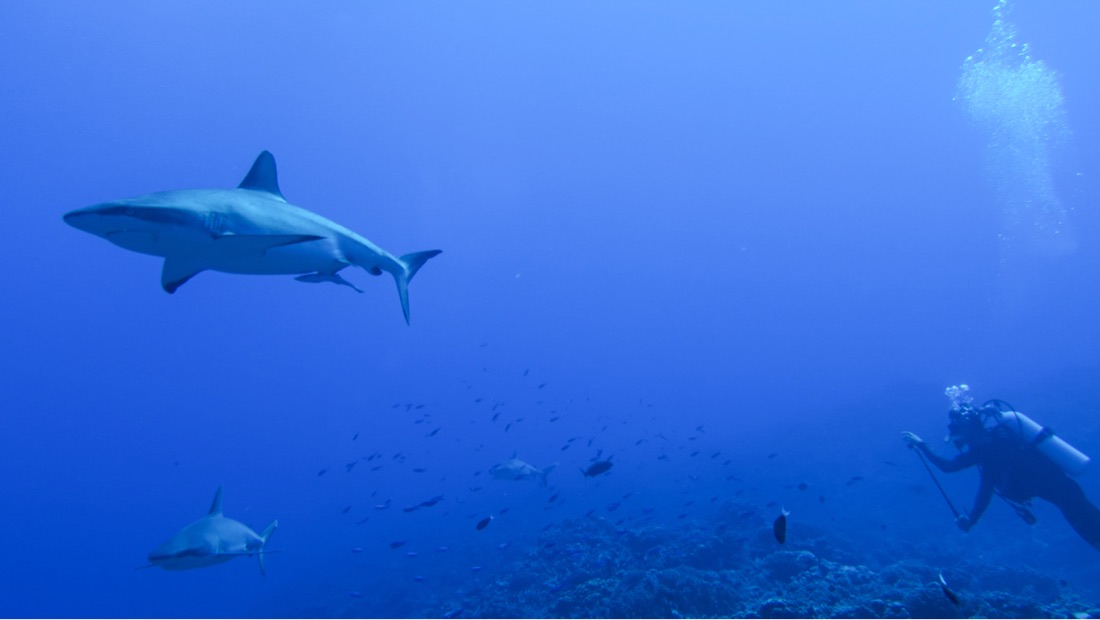
Besides blacktip sharks, heftier gray reef sharks also patrol the pass.


We attach the dinghy to a mooring ball on the outside corner of the pass, and drop down the mooring line for a SCUBA dive. We keep someone aboard as a dinghy operator, and the divers drift with the current into the lagoon.


Diyana with oncoming traffic. Fakarava’s south pass is famous for its “wall of sharks”. It begins at around 70 feet of depth.


The sharks become so numerous its unbelievable.


Running out of air quickly because our hearts are pounding !


Even returning to the mothership is gorgeous… note the currents in the pass in the background.


The ladies getting ready for a big night at the …. dive center. That’s the only thing around here. The closest town is at the north pass of Fakarava, almost 30 miles away (5-6hrs by sailboat).


What a fine looking crew! Especially with a backdrop of mother of pearl shells. It was time to say good-bye to our wonderful friends Matt, Diyana, and Melanie. They were flying back home the next day, after three weeks on the boat sailing from Marquesas to Tuamotos.


I tell you what, those colors just don’t get old…


Want to see what this amazing place looks like from the air? Check it out!  

Fakarava’s South Pass: Aerial Photos


Aldebaran anchored near the South Pass. The pass is located in an area with ideal protection from the prevailing SE trade winds – which is rare for Tuamoto passes

Fakarava is a World Heritage site, famous for diving. First though, we were blown away by the view from the air. Since the sun was shining and winds were calm, we flew the Honey Bee right after anchoring, to capture these pictures. 


Satellite images and nautical charts of Tuamotos seem to indicate they are uniform “rings” of land with lagoons in the middle. Not true… As you can see from this picture, most of the “ring” is composed of sparse bits of land with channels. In fact, the majority of the atoll is just submerged reef for miles on end, with no land in sight.


We’d like thank our Green Coco Patrons (www.patreon.com/greencoconutrun) for contributing monthly to our media & video fund. This fund allowed us to buy the DJI Mavic drone (among other photographic goodies) which lets us see and share these atolls from such an unreal perspective! 

Enjoy!


Notice the heart-shape in the coral reef! Here is a closer view of Fakarava’s South Pass, with the dive center & small rustic hotel that houses enthusiastic divers from all over the world. The structures extending across the reef are piers for docking boats; one pier even has a restaurant for visitors.


We were anchored with two catamarans and a large monohull on the first day. Lots of boats come to this spot. Rough ocean outside, smooth lagoon inside


Aldebaran in paradise… so proud of our old trimaran for making it down here!