“We have a leak!” Sabrina yelled. That is one of my least favorite phrases to hear on a boat. Especially when we’re at the start of a 3 night, 450 nautical mile passage with few good safe harbors.
Sabrina and Meggane reeled in a nice Crevalle Jackenroute to French Guyana; the girls cheered on.
We had just left the monstrous Rio Pará, timing the ebb tide to propel us out to sea, catapulting our way into the Atlantic as a decisive farewell to Brazil.
Current map courtesy of Copernicus on Windy; and the route plan on Open CPN from Belem to French Guyana.
It had been amazing 8 months in my home country. Seeing this land by boat is an entirely different experience. Navigating the coastline between the lush south of Rio where I grew up , the dry north-east of steady wind and sanddunes, and the hot soggy north of the Amazon rainforest; all whilst dodging fronts and sneaking into river mouths behind fishermen boats; attunes one to the mysteries of how geography shapes a place.
Case in point, being 100 miles offshore surrounded by mud-brown water from the Amazon River for 24hrs straight, offered us a sense of grandeur and awesomeness at the vastness of that river basin. Something you can’t absorb by reading a text book.
Crisp shadows painted on the muddy sea!
Then first mate Sabrina unceremoniously announced we had a L-E-A-K. My sense of contemplative nostalgia was shattered, and it was time to get to work in Six Simple Steps:
1) Bilge pump evacuates the bulk of water;
2) Taste the water to determine if salt or fresh (yuck?);
3) Use shop vac to thoroughly remove extra water;
4) Towels line the bilge and observe where water is pooling
5) Work upstream with more dry towels to identify where the leak is coming from.
6) Fix the leak in uncomfortable upside-down position.
Not the most flattering view of the boat innards.The original meaning of “cringe-worthy”
We aim to keep our bilges painted (last coated by Ian & Dophaise in South Africa, bless their hearts), clean, and bone-dry. That is essential to diagnose leaks in critical moments like this.
With 450 miles to go to French Guyana, we worked fast to make sure an emergency stop in the Amazon River wasn’t required.
We found the culprit quickly — a broken PVC fitting in one of the sinks. PVC plumbing was used in French boats of this vintage, but the modern best practice is to only use flexible hoses .
Alas, we must live with this occasional panic attack caused by cracked plastic. Perhaps this will speed up our quest to replace our plumbing one day.
Letting our skin soak with full moon rays while sailing underway has beneficial impacts on stoke levels.
Having enjoyed that cocktail of sweaty adrenaline & cortisol , we settled into the remainder of the passage, which had both the most calm and most blustery moments.
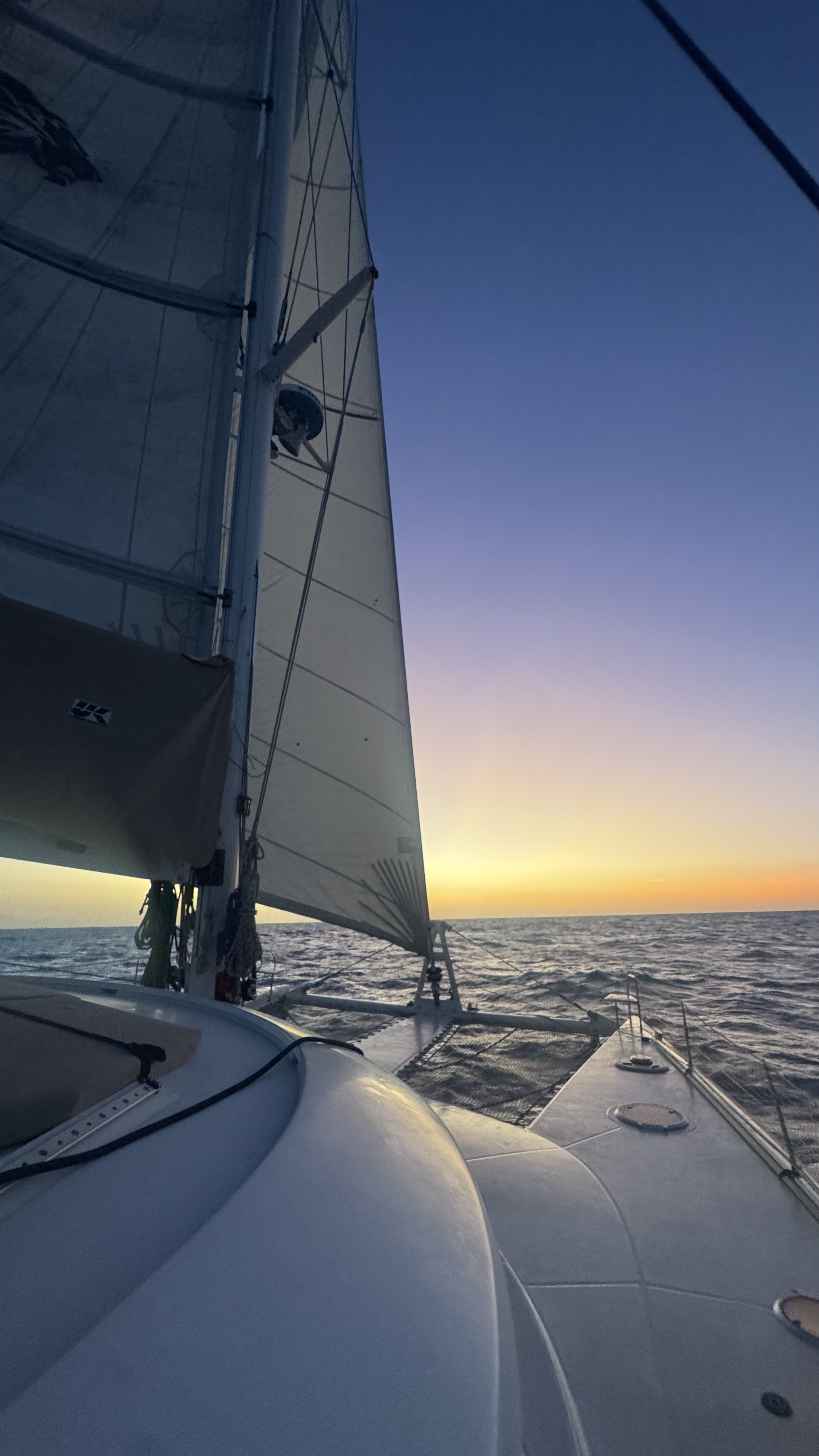
For 2 days straight, we rode the equatorial current north at blazing speed. The seas were so smooth it felt like Nesi was in a marina, not in the middle of the ocean, yet we sped along at 8 knots with full sail under broad reach. Simply Glorious.
Since Neptune enjoys some mischief, and invariably tests the ability of mortals to not get too lazy, at the inconvenient time of 1am on day 3, he sent us a 35knot squall of drenching rain, forcing us to quickly furl the Genoa and then reef the mainsail. Besides the confusion of waking up from deep sleep in 8 seconds flat, we were unable to communicate between the helm and the mast, due to the maelstrom of rain and cacophony of wind.
Soaked through to the bone, at least it is not freezing cold. The squall was a big one and lasted 3 hours — howling and propelling Nesi at 11 knots (in the right direction, this was a plus).
Nesi going 11.7 knots, 35 meters of depth , visibility zero. Pleasant working conditions. 45 degree rainfall at 1am.
This second cocktail of adrenaline & cortisol was compliments of the Earth’s Equator, which is an efficient (if chaotic) distributor of excess solar energy. It is the fuel that drives the entire globe’s wind patterns and currents, largely responsible for the habitable conditions on our planet. So we can’t complain about the occasional slap in the face as our puny little crafts attempt to transit this zone.
Few sailors love to go through the equator due to this ground zero effect, where unpredictable winds and squalls are the norm. Perhaps this is why there are some notable traditions for greenhorns crossing the equator.
However — between the panicked leak and the panicked squall, we didn’t really give our greenhorns a proper hazing. Shucks!
We did make it to French Guyana in one piece, in darn good spirits, which are two goals to celebrate.
Sabrina putting up our Yellow Flag which means we’re arriving on a foreign vessel without having yet cleared immigration.
Loved this? Watch the reel (1:20) about the experience:
This was our first time in a giant river! Once we arrived in the Amazon Basin, everything changed dramatically.
We sailed overnight from the sand dunes of Ilha Lençois, then up the river into a tropical rainforest…
We went 50 nautical miles up the river = 8hours at 6 knots… it’s a loooong way! We couldn’t even see the other side of the river, it’s immense.
It’s our first time seeing rain clouds and dense forest in a month… The sand dunes and dry sunny conditions of northern Brazil are now behind and we’re officially in the rainforest Equatorial region. It’s super tricky, but we manage to time the currents to arrive before sunset at the dock in the periphery of Belem.
Checking out of the country was challenging because we had received a non-standard extension of time, while we were in Fernando de Noronha. But the Belem officials were gracious and everything worked out.
On our way out, we couldn’t time the currents, so we stopped overnight in the river village of Soure, which turned out to be a highlight, with water buffalos, bike riding, ceramics, and river estuaries. Then we sailed 3 days to French Guyana.
lateJuly 2025 ~ Within 2 months of our visit, two sailing yachts wrecked on the sandbars of Ilha dos Lençois — so it is no joke!
There are many shifting sandbars and deceptive currents in this remarkable island. It’s known to be safe and dangerous at the same time. How is this possible?
To safely approach Ilha dos Lencois, we took our navigation seriously. Navigation comes in 2 parts: Preparation (what we do in advance) and Presence (what we do in the moment).
Preparation is basically an attempt to visualize all possible futures — peering into the crystal ball. When will the wind and tide and sunlight align for a best condition for safe entrance? What’s our backup plan, what does that look like? Curiosity (and some degree of anxiety) are very helpful to motivate preparation. It drives us to collect information (sailor resources, study charts, tidal info) and try to make a decent working Plan. Not forgetting, of course, that the “plan” is simply a roadmap that might (will) be changed.
Presence is where the “rubber meets the road” . We need to rely 100% on observation and instantaneous response, based on intuition, experience, and the knowledge gained from Preparation. Watching the wind & waves, the clouds, the depth sounder, the charts, reviewing notes. Preparation is the guide book outlining a plan; Presence is the guide that, in the moment, alters the plan.
We sailed overnight from Atins, and arrived just after 10am (with good lighting) in the region littered by sand bars surrounding Ilha Lençois; and entered on the incoming tide (in case of running into a sand bar, the tide is rising!)
Disorganized seas confused us at first. Eyes go from chart to reality and back. Is that an unmarked sand bar? Why is the water color an odd milky seafoam green?
We pick our way into the estuary of Ilha dos Lençois, rewarded with an incredible experience: like anchoring in a calm river with mangroves on one side, and magnificent sand dunes on the other.
We reveled in the surreal light that plays on the dunes. We spent a few night, visiting the village, kayaking through the mangroves — it was relaxing and wonderful.
July 2025 ~ We had an unbelievably great time in the north coast of Brazil. It was so exciting to explore this part of my home country (Capt K was born in Rio)!
Unusual for Nesi, we had no co-op visitors during this period. The reason is that customs & immigration in Brazil has been very unfriendly to cruising sailboats, and left us completely unable to plan our schedule, in the face of too much uncertainty.
In exchange, we welcome 5 work-trade crew members aboard to help us with boatwork, the kids, our videos, and business development. It was a very international crew: Egypt, Madagascar, Germany/Namibia, USA, and France were represented! More on these great crew members later.
The first stop after the heavenly island of Fernando de Noronha was Galinhos, off-the-beaten path destination near Natal (read about these two places in our last post). Then we sailed overnight to Paracuru, a random little town along the coast where we had organized to pick up a package … the things that we must coordinate as sailors!
Paracuru:
Paracuru was an unpretentious, “real” town, non-touristy, just doing its thing. We enjoyed the visit but the wind wasn’t any good for kiting. Then we sailed overnight to Jericoacoara, which was the exact opposite!
“Jeri” as locals call it is an end-of-the-road sandy point which has attracted an impressive amount of visitors for its beautiful dune scenery, party-goers for “feet in the sand” dance clubs, and lots of kite/wing foilers in the steady trade winds. The narrow alleyways through the town are charming, creative artwork spills everywhere, but the quads and 4×4 trucks and touristy crowds are a bit hectic. The anchorage was quite rolly and the tides are extreme, we had to dinghy thru lightly breaking mini-waves, it was challenging! So we only stayed one night, before carrying on to the gem of the coastline: Atins.
“The best can also be the hardest” — this was the case in Atins, which has an infamous rivermouth to navigate. Very few sailors make it into this river due to the chaotic breaking waves. We hired a fisherman as “pilot” to guide us thru the entrance, and it was still a nail biter! But spending a week in Atins was one of the highlights of our time in Brazil, like dropping into a forgotten village with lots kitesurfing and great people.
We had an unforgettable lunch where we kited to the sandy peninsula, in the middle of nowhere surrounded by sand and sand alone, and had amazing shrimp pastéis. We kited offshore downwind through the surf to the Lençois National Park and met our crew and kids in the truck. Rode in butter smooth lagoons surrounded by dunes. Unreal!
This coastline left such fond memories in our heart. So much adventure, challenge, fulfillment, and fun. The desert kiting and remote rivermouths in Brazil’s north coast are worth seeing!!
Up next: we sail to Ilha dos Lençois and onward into the Amazon Basin!
Meggane comes from France, and has experience in outdoor education AND teaching children French. A perfect fit! Learn more below about her favorite teaching activities, experience with life aboard, and the Green Coco Expedition.
See here more about the boat school + teachers that have been aboard
Where did Meggane meet us?
Nesi was inside the rivermouth of Itacaré, a bohemian surf town in Bahia, when Meggane arrived. It’s one of our favorites spots! It is surrounded by Atlantic rainforest, water-sports & health loving folks, samba music and safe, good vibes.
Itacaré Fresh Fruit DrinksRivermouth anchorage (Nesi at back)First Day at Sea! Wahoo!
Meggane quickly settled in with the kids and the boat space (she has even worked on a commercial fishing boat in Australia) so it was all smooth sailing.
What does Boat school aboard Nesi look like?
The intention is for school daily at 9am-12:30pm, lunch break, 1:30-2:30pm wrap-up activities, followed by play time in the afternoon.
However, since the boat is always moving into new places, the dynamic is always changing!! Meggane did a great job adapting to these 3 environments:
SCHOOL DURING PORT DAYS: This is the easiest. When Nesi is docked or anchored between trips, daily school happens as planned 9-12:30pm , usually onboard or at a friendly restaurant on shore; followed by beach time and nature exploration in the afternoon.
SCHOOL UNDERWAY. When we are sailing at sea, it really depends on conditions, If it’s calm enough, we do 1.5hr of school, otherwise the girls like to do arts & crafts, imagination stories, play Legos & magnetic tiles (these are their daily staples!)
SCHOOL DURING CRUISING TRIPS. During our guest trips (as shown in our schedule) we’re always doing loads of fun stuff !! Example: when the Darling family & Dan (co-op members) visited for the Recife-Noronha leg. During these times there’s A LOT of distraction, plenty of people aboard, and we are exploring exciting places every day. Nevertheless we try to squeeze in 1.5hrs of school in the day, in between excursions and playing with other kids; with occasional full school days when guests do their own thing. It’s a lot to juggle, but it’s fun!
A few highlights from our Recife to Noronha leg with co-op guests follow (see reels here):
3000 nautical miles from Brazil to Caribbean
It’s a LONG WAY to the Caribbean, with tons of awesome spots (and challenges). On this route we got a huge variety of conditions.
CENTRAL BRAZIL: After Itacaré, Meggane joined us during a special time — we were visiting Captain Kristian’s mom, dad, and sister who live in Bahia! Then we sailed 3 nights to Recife, which was wild and wooly riding cold fronts up the coast to Noronha (see This Post to get a sense of things)
NORTH BRAZIL: we sailed offshore 2 days to Fernando de Noronha in blustery seas for a glorious week visit. Then it’s time for the “turbo-chargers” as we ride 25kt winds downwind for 1000 miles past the big “corner” of Brazil: Natal’s Cabo San Roque. This is the area of giant sand dunes, world class kitesurfing, river mouths like Galinhos, Jericoacoara, Atins, Ilha Lençois. So memorable!
AMAZON BASIN: we sailed 50 miles into the strong, tricky currents of the Rio Pará to reach Belem with its misty forests and water buffalo in Marajo. What a crazy contrast.
AMAZON TO FRENCH GUYANA: We checked out of Belem (a very complex story for another time) and had the most blissful 3 night 500nm sail… except for one mega-squall that smacked us bad at midnight with 35kts. We had a wonderful rest at the Iles du Salut in French Guyana. I didn’t know this is actually a “department” of France (like a state) and technically it’s the only EU land in South America! The EU space program is hosted here, since it’s near the equator.
FRENCH GUYANA TO TRINIDAD & TOBAGO. Finally we had a very SLOOOOW 5 nights with no wind to Trinidad, expected due to the Intertropical Convergence Zone (a band of disturbed air around the equator) plus Hurricane Erin in the north was sucking all the wind out of sight, and causing occasional 25kts squalls headwinds, to add injury to insult. Typical equatorial chaos!
TRINIDAD. After long days and too much motoring, we finally pulled into the large island of Trinidad to dock Nesi at Peakes marina for a maintenance period and wait out the hurricane season safely – insurance requires us to be south of Grenada for hurricane season (which they very conservatively estimate as June 1- November 30). Now it was time for boat work and the kids flew back to Brazil to spend time with Grandma Susie.
What an awesome trip and unforgettable experience that we shared together. Meggane was truly exceptional in her ability to adapt to all the different environments and give the girls a consistent, learning presence.
Thank you Meggane , we love you!
Captain K & Sabby
———————-
About Meggane:
Hi! I’m Meggane and I’m from Lyon, France. I’ve spent the last 14 years traveling, living and working around the world. Even though my main profession is teaching, I also work with animals, agriculture, fishing, and even construction of eco-friendly houses …The world is a playground for learning!
Thoughts on life aboard:
I spent the last few years living in my van, so the boat life was easy to adjust to. I particularly enjoyed spending time with our crew of friends from all over the world — Dophaise from Madagascar, Karim from Egypt, Alex from Germany/Namibia, and Kaitlyn from the USA.
L to R: Dophaise, Sabrina, Naiyah, Kaiana, Kristian, Karim, Kaitlyn, Alex, Meggane. This was our passage crew from Brazil to Caribbean
Aboard Nesi, I also really enjoyed the incredible nature that constantly surrounded us. Whether underwater or on land, we were almost always immersed in nature, and I loved observing the fauna and flora evolving as we sailed up the coast.
A huge highlight, of course, was my time spent with the girls. I loved everything about our days together. They are two funny, creative, joyful, and positive little souls.
One big challenge was the long working hours on the boat — there is always something to do on a boat! Between school time, cooking & community tasks, and even night watches, it was tough to find personal time that I’m used to having. This certainly took some adjusting!
Highlights from Sailing:
Amazon
Ilha Lençois
Ilês du Salut
Phosphorescence in Trinidad
Our arrival in the Amazon was so special to me. After spending time around the vast sand dunes of the Brazilian coast, sailing along the Rio Pará, with its lush forests surrounding us, tropical birds singing from every direction, and meeting the welcoming and cheerful locals, it all felt so heartwarming.
I also really enjoyed kayaking through the mangroves at sunrise on Ilha dos Lençóis. It was such a magical moment, watching the colorful ibises in the calm, peaceful morning!
Ilha dos Lençois
I absolutely loved our stop at Îles du Salut. After several days of open ocean sailing, arriving at such a breathtaking place was truly unforgettable. It was fascinating to learn about these islands, rich in history, and to walk through their incredible jungle. I really enjoyed discovering this amazing part of France that, unfortunately, I hadn’t known much about before. It opened my mind to the French overseas departments and prompted me to do some research on these places that aren’t talked about enough in France.
Iles du Salut
Speaking of magical moments, I’ll never forget swimming in bioluminescent waters while anchored in Chacachacare, Trinidad. The water was glowing, the girls were dancing in it, and we even went snorkeling, feeling like superheroes in that glowing night!
Arrival in Trinidad – Celebration!
Favorite Activities with the Kids:
French
Learning from Nature
Arts & Crafts
Storytelling
Below is a detailed look at each of the above 4 activities.
French
One of my main goals with the girls was to help improve their French skills, in anticipation of their upcoming family reunion in Martinique. They already had a small foundation in listening and speaking French (thanks to Zoe and Ian), which made it easier for me to continue building on it.
We had so much fun learning — through games, creative activities, and exploration — that they didn’t even realize how much they were learning along the way.
French Field Trips
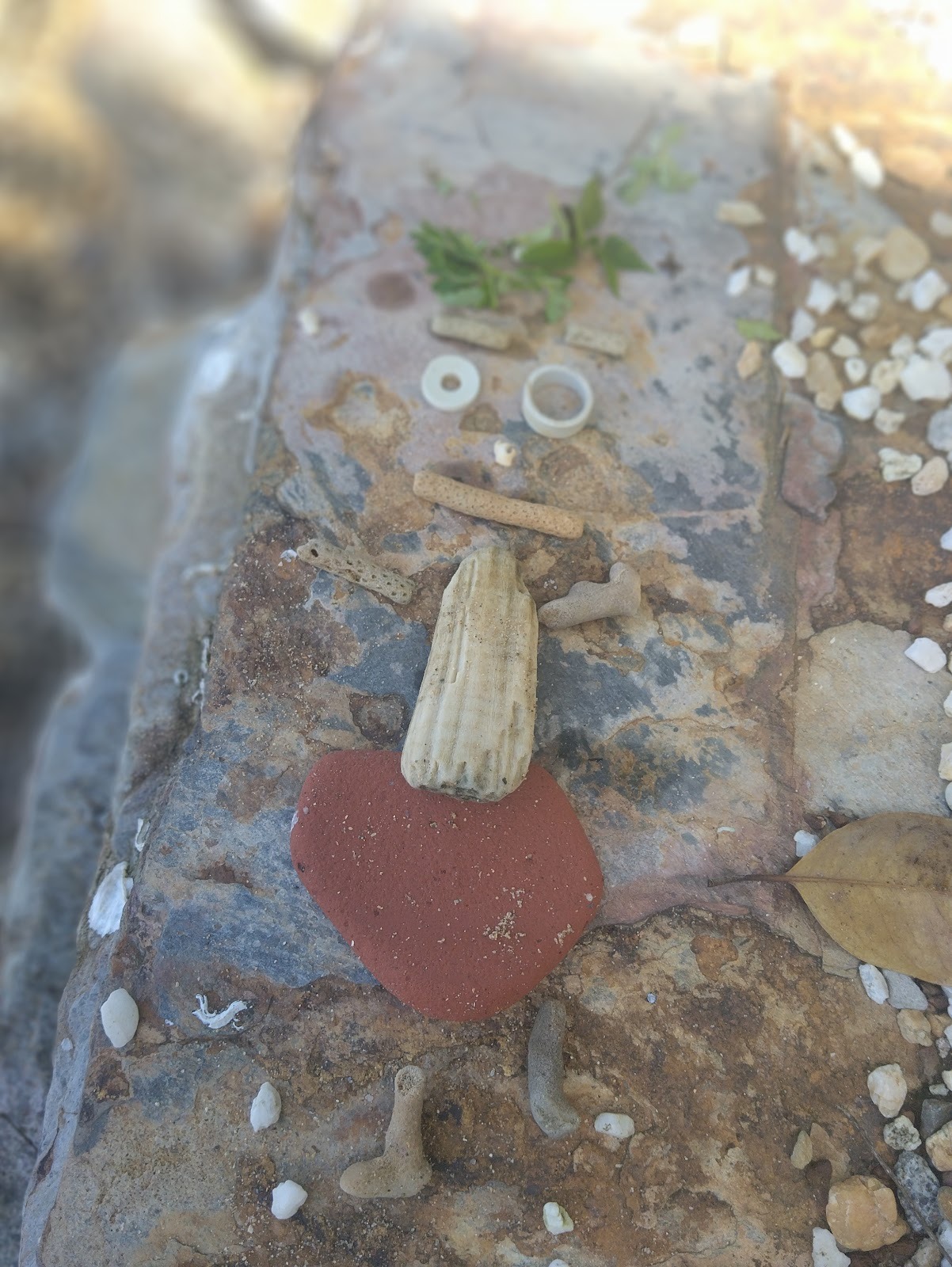
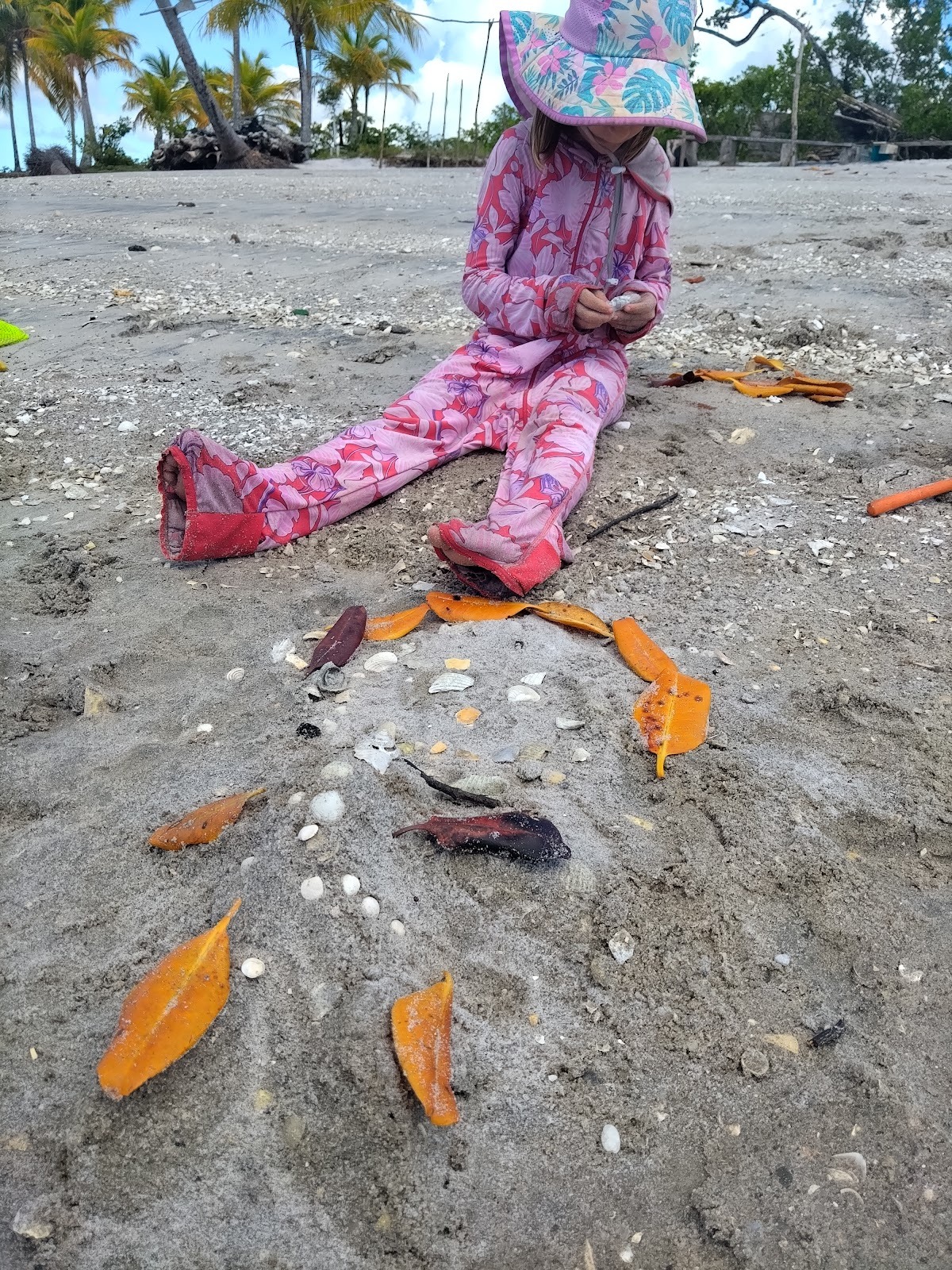
One of the best ways to practice French is to simply get off the boat (away from English speakers), head to the beach, and play in the sand — all in French. The girls are so imaginative and full of creativity! Every time we were on the beach, we’d come up with a new story together, and they could go on for hours — digging a river, building a castle, a volcano, a beaver’s lodge, or burying my feet, pretending they were little creatures trying to breathe and escape their sandy “prison.”
Imagination has no limits… and with it, we added so many new French words to our vocabulary. I always spoke to them in French, but I never expected them to answer only in French. Most of the time, they’d use or repeat some words or small sentences— which was already amazing! The goal was to immerse them in the language, help them realize how much they could already understand, and celebrate every little French word or sentence they gave me. It was all about making them feel proud and confident.
Frenchgames
Games are another great way to learn. Every new game I brought on board was introduced and played fully in French. I would explain everything in French (with lots of gestures when needed!), and if the girls didn’t understand, they’d just ask, which they are good at doing.
One classic game any French child knows is “Le jeu des 7 familles”. It was one of the first educational games I brought, and the girls absolutely loved it. It’s fast-paced, easy to understand, and allowed us to work on several areas:
Animal vocabulary and their habitats (ice floe, jungle, savanna, house, desert…)
Fun facts about each animal
Counting
Games also teach the kids useful card-related expressions, such as:
Pioche une carte (Pick a card)
C’est ton tour (It’s your turn)
On est une équipe (We’re a team)
Other games we play in French:
Uno – for practicing colors and numbers
Cactus – card game focused on math, calculation and memory
Dobble – fast-paced vocabulary practice
The Smurfs memory game – excellent for learning adjectives (like Le Schtroumpf Farceur, Gourmand, Bricoleur…)
Similo – working on animals, similarities and differences
What I really like about these games is that they are quick to play, can easily fit into any part of the day, and most importantly, the girls loved them. Thanks to the repetition built into the games, we were able to pick up new vocabulary very quickly.
Legos
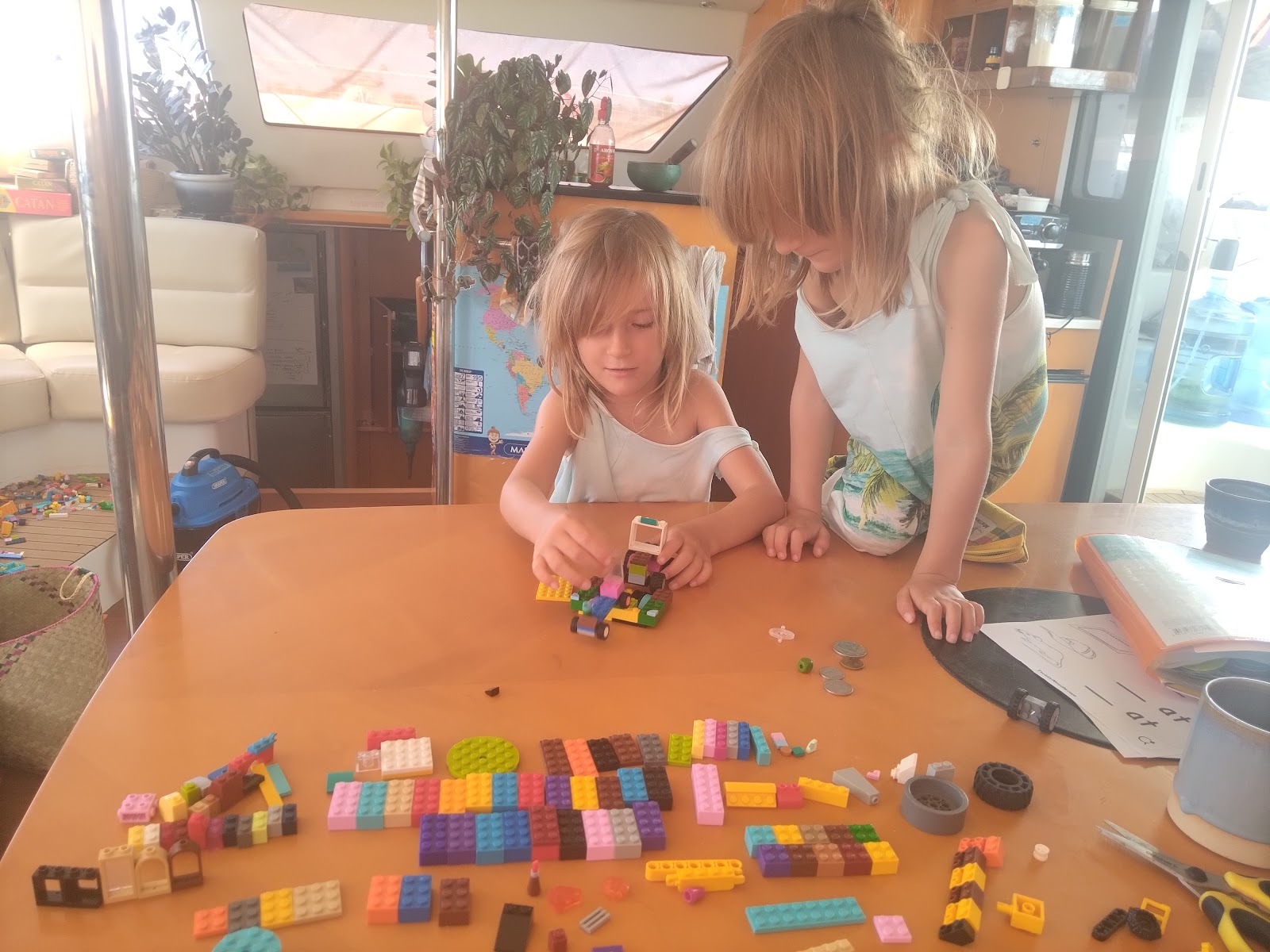
The girls are absolutely obsessed with Legos — they can build, destroy, and rebuild for hours! One day, instead of interrupting them for school, we turned Legos into school.
We turned the table into a pretend Lego store. I laid out all kinds of Lego pieces in front of me (different shapes and colors), and the girls had to “shop” for parts to build a car.
That’s how we introduced shapes, new colors, prices and questions you could have to ask at the supermarket:
J’aimerais le petitLego bleu.
Le carre?
Non, le petitrectangle.
Ok, ca coute 8 dollars.
Et le Lego plat, vert clair?
They looked at their coins, counted, calculated, and gave me the “change” for my payments 🙂
This activity was so complete — and they were having so much fun, they didn’t even notice they were working on so many skills, such as:
French vocabulary (colors, shapes, questions, numbers)
Math and basic operations
Observation, anticipation, teamwork, and planning
We also did something similar with coloring — one of us would be the “shop owner” with markers, and the other had to buy colors to finish a drawing — all in French.
Body parts in French
Here’s another example of a fun vocabulary activity.
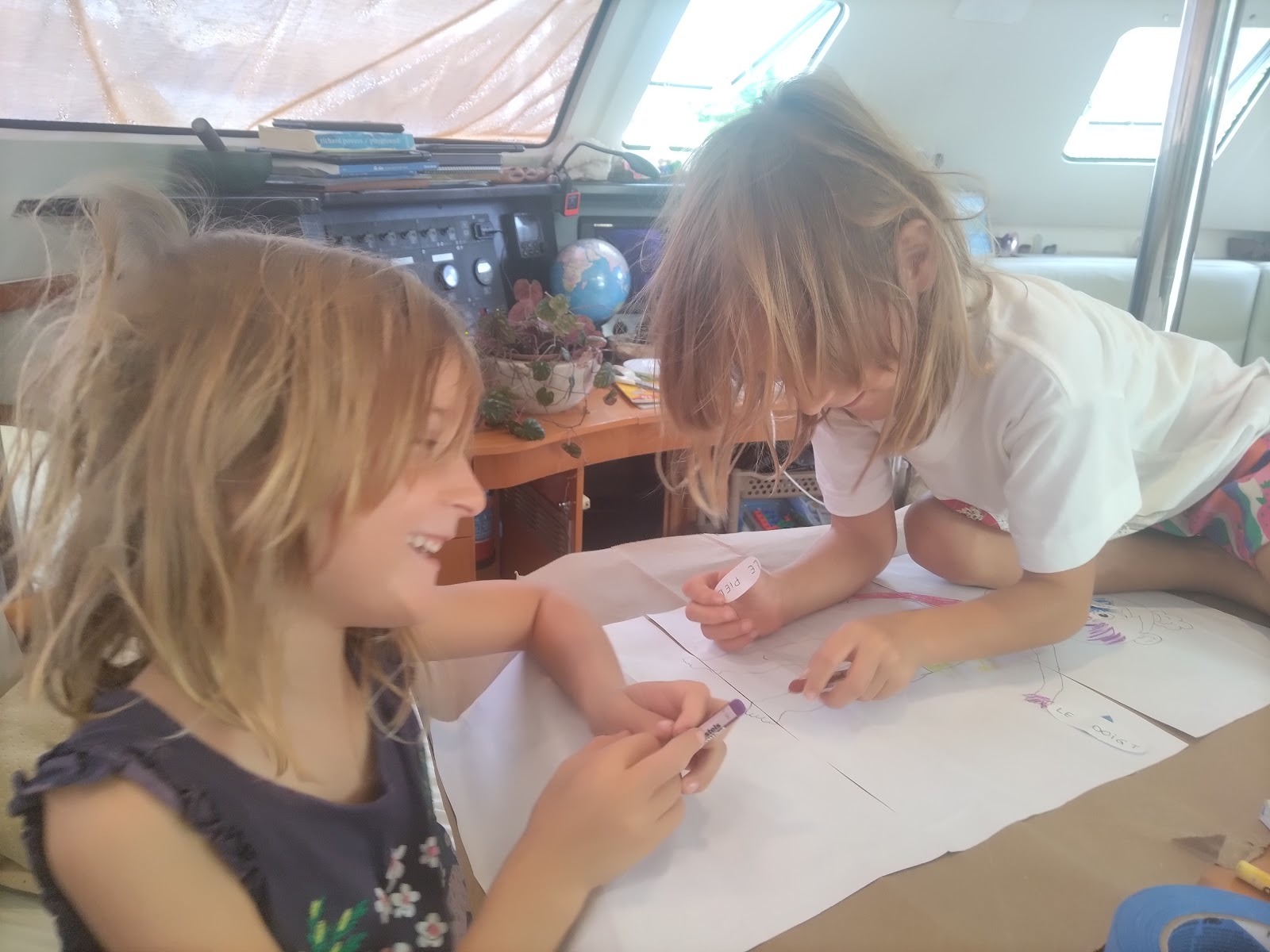
We drew a giant kid on a piece of cardboard. I wrote names of body parts on small pieces of paper, which the girls would draw from a “magic box.” I’d read the word out loud, and they had to stick the label in the right spot. As a reward, they could color that body part!
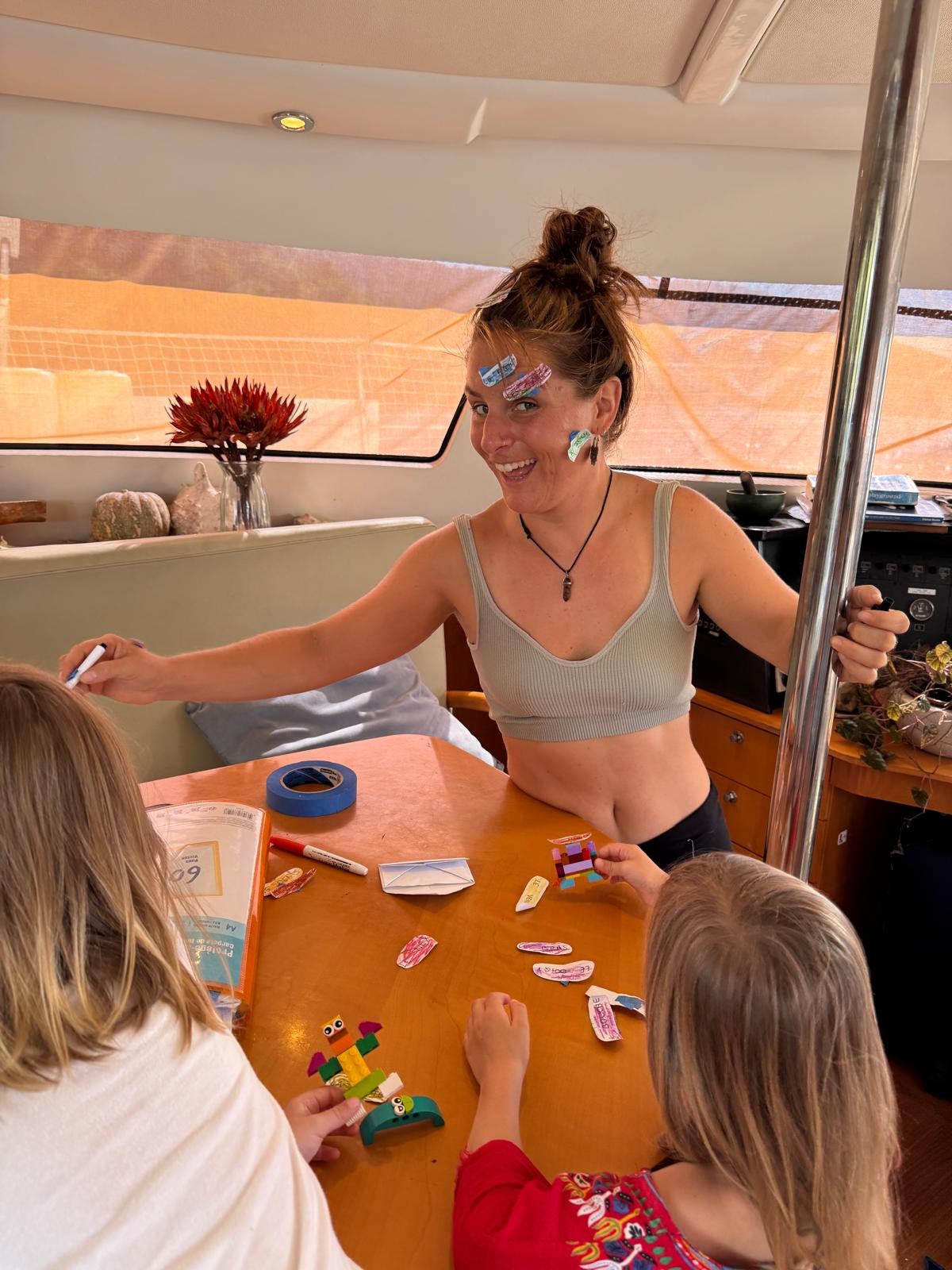
Another variation was sticking the labels on my body — which they found hilarious, especially when it came to funny parts like teeth or elbows!
LEARNING FROM NATURE
Aside from French, we also learned biology, science, math, writing, reading, music, and arts.
The Green Coco world schooling approach is to learn from nature & culture around us — which I absolutely love.
Example: on a beach day, we found many sand dollars on the water’s edge. We picked some up, (dead ones), observed them and we became so curious about these fascinating creatures, asking: What do they eat, where do they live, how are they structured?
This curiosity led to a a Sand Dollar Project, including:
Research about sand dollars and their family
Making salt dough and creating sand dollar models
Exploring fine motor skills and artistic expression
Comparing them to similar species
Learning about their common traits and differences
We then connected our next activities to that one, to learned about other species from the same family (starfish, sea cucumbers, brittle star…).
Everything around us can be the source of inspiration, if we just follow our curiosity!
ARTS & CRAFTS
I loved our craft afternoons — painting, building, drawing… filling imaginations with color.
One activity I particularly enjoyed was making macramé and micro-macramé bracelets with the girls and two of our young guests during our Fernando de Noronha trip.
Macramé is a craft technique that involves knotting cords or strings to create decorative patterns and designs. Micro macrame uses the same technique but with thin cords or threads. I thought it was a great way to learn knots — a useful skill on a boat!
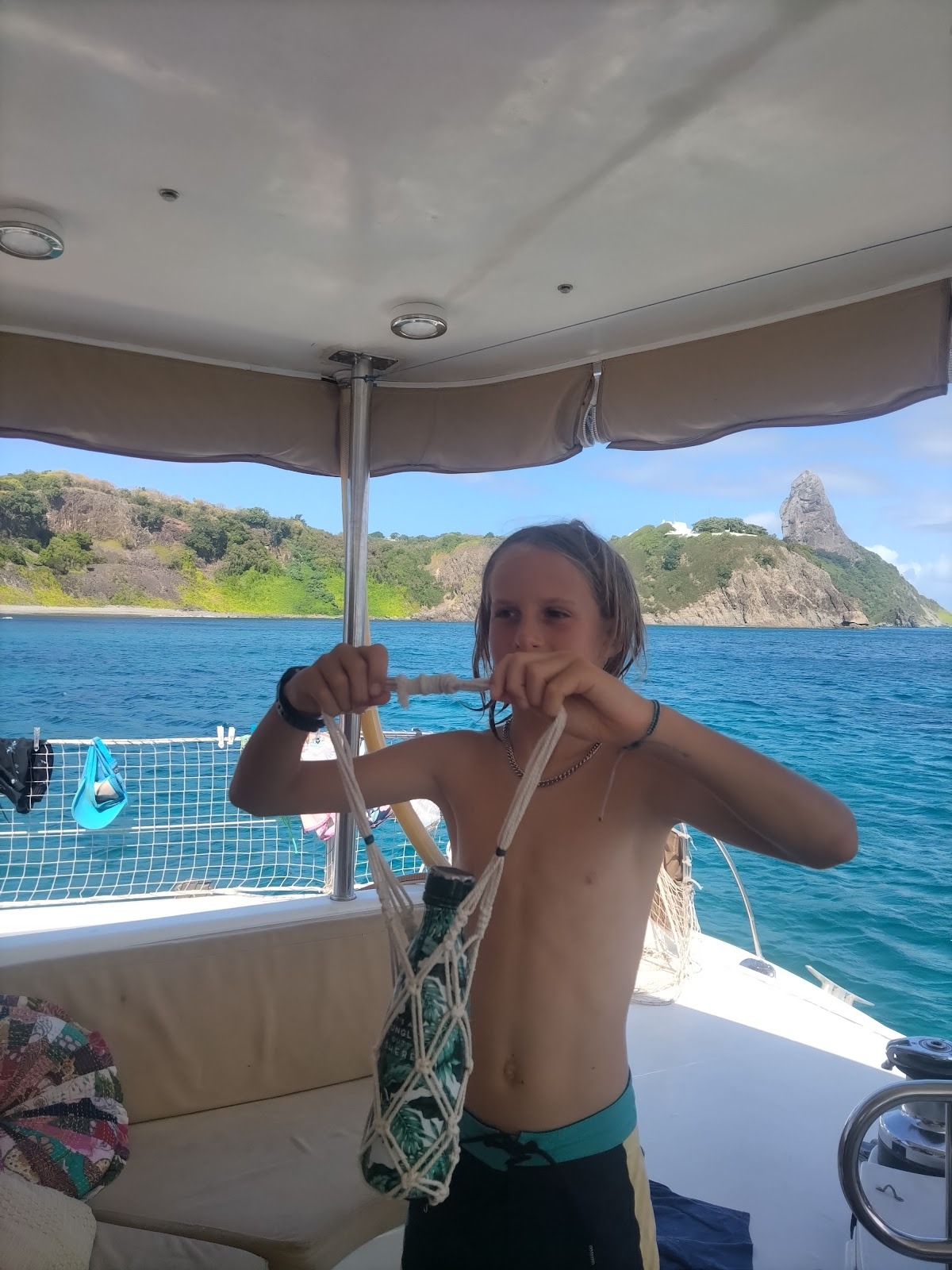
The girls were very focused and created beautiful patterns. The 9-year-old visiting the boat with his family even went further and made a water bottle holder!
STORY TELLING
Story telling is an incredibly creative activity. The first time we used the Dixit card game, with its beautiful watercolor illustrations. Each of us picked a card that inspired us. I would usually offer a card showing a character, and the girls would invent details about them — name, origin, personality, hobbies…
Then, we’d connect the characters. We’d ask: Did they know each other? Would they meet? What happened next?
As our imaginations flowed, we’d draw more cards, sometimes picking blindly, sometimes choosing intentionally — and our story would continue to unfold!
The first time we played (and the next too!), we couldn’t stop, we played the entire morning.
Over the three months, we kept returning to the game, adding inspiring cards from other games. We created so many amazing stories together!
FINAL THOUGHTS
It’s hard to pick favorite activities — it’s truly been an incredible three months with the girls. I loved everything we did together. We turned every activity into a game, and every game into a learning opportunity.
I’m deeply grateful to have shared Kaiana and Naiyah’s daily life. We had so many unforgettable moments, and I learned so much from them! These two beautiful, free spirits reminded me every day that learning doesn’t need walls or desks: it can happen anywhere, at any time, when curiosity leads the way.
Kaiana and Naiyah — keep being your amazing, joyful, creative selves. Stay curious, stay playful, and keep being excited about life and the world around you.
The world is a playground for learning. You can prove it every single day!
After a two night passage (250nm) from Recife, we dropped anchor in Fernando de Noronha — a volcanic island rising straight out of the Atlantic. We arrived at the beginning of July and spent a week exploring what makes this place legendary: its underwater world.
After 5 days in Noronha with our co-op crew (Taylor + family, Dan) we had another 5 days to consolidate our new crew members, who arrived by plane for the passage along north Brasil to the Caribbean.
Wind in the corner of Brasil is STIFF and predictable. Once we left Noronha, we got 25-30 knots from SE as we headed around Cabo San Roque towards Galinhos. Nesi going WSW course, this was a good broad reach, blasting along at 8-10 knots of boat speed.
Sharks & Dolphins of Noronha:
I was diving under Nesi when WHOA! A pod of dolphins cruised right by. What a sight! But not so surprising, because these dolphins visited us every day for our 9 day stop in Noronha… we also had spectacular moments with sea turtles, nurse sharks, octopus, and more.
Fish of Noronha:
This is one of the reasons why we love living on our boat: jump off the stern and swim with fish in clear water. Below Nesi there were Sergeant Major , Atlantic Chubs, Barracuda. By the shipwreck at the port we dove with French Grunts and sea turtles.
From Noronha to Galinhos:
Such a cool village! We were concerned about the rivermouth so we hired a pilot to lead Nesi into the river. But it wasn’t a big deal. Loved being anchored in this remote corner of Brasil that nobody has ever heard about.
Galinhos Village:
Galinhos is from another Era! We loved exploring this rugged zone.
Galinhos deeper in the river:
Going deeper into Galinhos river, kiting & sand boarding the dunes, and visiting villages.
Where is Nesi right now, you’re wondering? What’s life aboard like?? Since our Atlantic Crossing in January we’ve been in Brazil 🇧🇷 .
We spent nearly 3 months in the Rio de Janeiro & Angra do Reis region running co-op trips with 5 groups of members. It was a blast!
Then we started a 1,500 nautical miles, 1.5 month passage up from Rio’s bustling city to the crown jewel of Fernando de Noronha. Here’s the Map Overview:
We left in mid-May and had to ride burly cold fronts with their blustery & rainy south winds, in order to head north against the predominant winds (which blow NE in this stretch of coast). This is considered a good time of year to head north, because the cold fronts bring south wind during Brazil’s fall & winter (May to September).
Atlantic Crossing via St. Helena & Martin Vaz in January (read posts); landfall in Rio de Janeiro by mid February; then heading north by mid-May.
Below are a series of Reels showing the journey. They are 1-2 minute vertical videos best for phone viewing. If the Reels don’t sure, open the blog post in the browser.
Rio to Abrolhos: 3 day passage, 450nm
This passage was technically very difficult ! Timing the cold fronts is quite challenging — pick one that is strong enough to sail, but not too strong and chaotic… We did ok, motoring ahead of a cold front for 12hrs in total calm, then riding the frontside of the front for 1 day of beautiful sailing, before the low pressure caught up to us. Then it was wild & wooly with rain, gusty winds, and confused seas for 2 days, nevertheless, pushing us in the right direction. Complicating factors were the contrary currents off Cabo São Tomé , and the hundred oil rigs and oil supply boats in that coast that act like a minefield. We arrived in Abrolhos sailing with 15-20kts of SE wind and sunny weather — ready for a rest!
Abrolhos: 5 days in this marine national park
The Abrolhos National Park in Brazil is the kind of place sailors like us love to visit. Boat access only, way offshore (almost 40nm), with lots of marine life and historical significance. We spent 5 days exploring the archipelago. Since it is highly regulated, we were allowed to anchor in 3 places: the Ilha Santa Barbara north & south sides, and between Ilha Siriba and Redonda. All the anchorages were rolly and exposed. Snorkeling was good with large fish — but the most amazing were the birds!
Itacare: grooviest surf town in Brazil!
After a light wind 2 day + 1 night passage, we entered our first rivermouth: Itacaré. It is hair raising to go through sandbars with waves breaking on either side — happily we had a fisherman pilot us in. We LOVED our time in Itacaré , dancing to samba, eating açai, and met up with our friend Carola (who sailed on Selaví in Fakarava with us 2 years ago!), who sailed north with us to Maraú.
Peninsula de Maraú: the dreamiest spot on Brazil mainland
Our goal was to arrive in time to celebrate Sam’s birthday (Kristian’s sister). We also managed to accomplish this in Mazunte, Mexico on Aldebaran in 2015, visiting Sam for her bday there! It was a special time, spent with the Beadle family in their beach side house. Our new boat school teacher Meggane from France also came aboard. Bienvenue!
Sailing to Recife: 3 nights of glory and pain
This next stretch 3 day passage to Recife, in north east Brazil, also proved challenging. We did exactly the same technique as when we left Rio — ride a cold front with southerly winds up the coast. The first two days were glorious. Then it was rough and wet! 25-30kts of beam wind, sideways rain. Worse, we discovered that our starboard engine had a MAJOR issue — the massive bracket that holds an alternator sheared off. So we couldn’t use the engine, and had fingers crossed that we would fix it in Recife.
Sailing to Fernando de Noronha: with co-op families
This was a super memorable trip! Taylor and family from Santa Cruz came back, they joined us last year in Madagascar and now were ready for an overnight passage to Brazil’s most famous island. First time visitor Dan from San Diego is also a co-op member with lots of sailing experience, which was a big plus. We visited Olinda’s colonial town, the super tricky river entrace of Maria Farinha, and then set sail 2 nights… bumpy, fast, and great weather. Taylor’s kids were troopers — they earned their offshore badges!
Next time: see the highlights from Noronha and our travels on the north coast of Brazil hunting for kitesurf spots and the biggest sanddunes next to the water’s edge we could find!
How do we ride the ups and downs of a 15 year circumnavigation? The first year was a battle around Africa. Now in our second year, we are licking our wounds, enjoying the gold of Brazil’s calm & beautiful anchorages 😅🏝️
Read our newsletter about the Pirate history in Brazil and how we’re now reaping the rewards of this great cruising coastline… and preparing for the next phase in the Caribbean.
Highlights:
Our latest crew included another set of 4 year old identical twin girls (!), and all types of visitors young and old.
Don’t miss: your chance to win a FREE TRIP: subscribe to Expedition Letters.
The history of colonial Paraty’s wealth, downfall, and revival